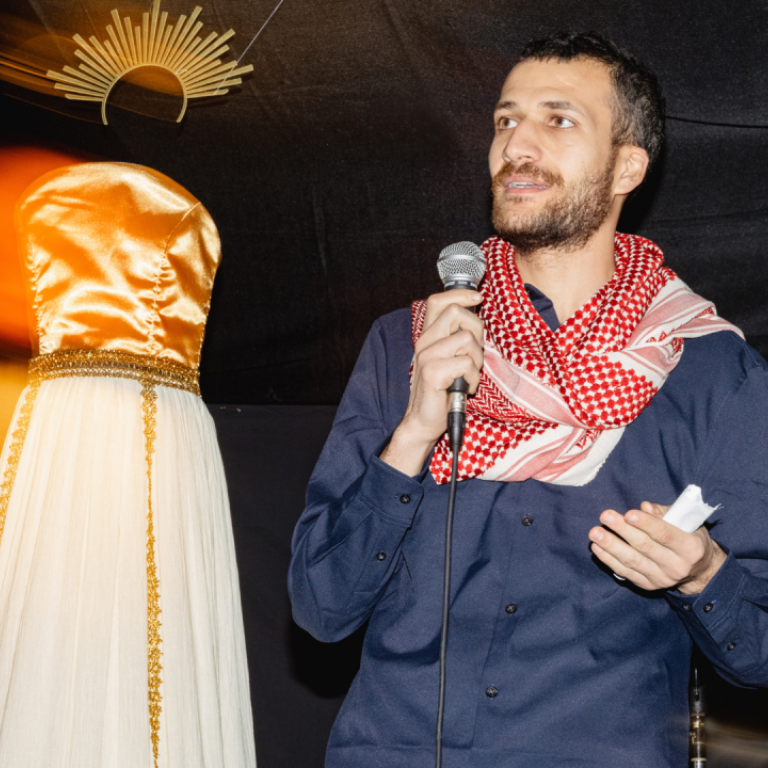
Every year, students develop a Personal Statement: a work that uniquely represents who they are. They then share this work with the rest of the design community on a special Personal Statements Night. This project allows the designers to combine a physical product that is imbued with their emotions and values with a shared user experience. Ahmad Abubaker shares his 2025 Personal Statement project in his own words.
Introduction
In my last two years in Jordan, my love for design found its main platform—making!
In 2019, I co-founded ‘Naqsh Science’, an initiative to build and produce science shows and kits in Jordan, and in Arabic. Because of the constraints we had and our curiosity about how things work, we designed and built everything on our own. Starting from the stages of our shows, to the science experiments, to the social media posts. Building and testing the science experiments was the most enjoyable part of the project. It was also the part that was the most impactful for me. I realized how powerful intentional making could be. I came to Stanford to grow as a designer and maker.
I was lucky to be a part of both the d.school and the Product Realization Lab (PRL), where I worked as a course assistant over the last two years. This enabled me to learn and observe how people from different disciplines and backgrounds design and make. The "Loftees" (an affectionate term for the design grads) and PRL course assistants were my primary source of inspiration, feedback, and support in my time at the d.school.
Personal Statement: Their memory is my hope
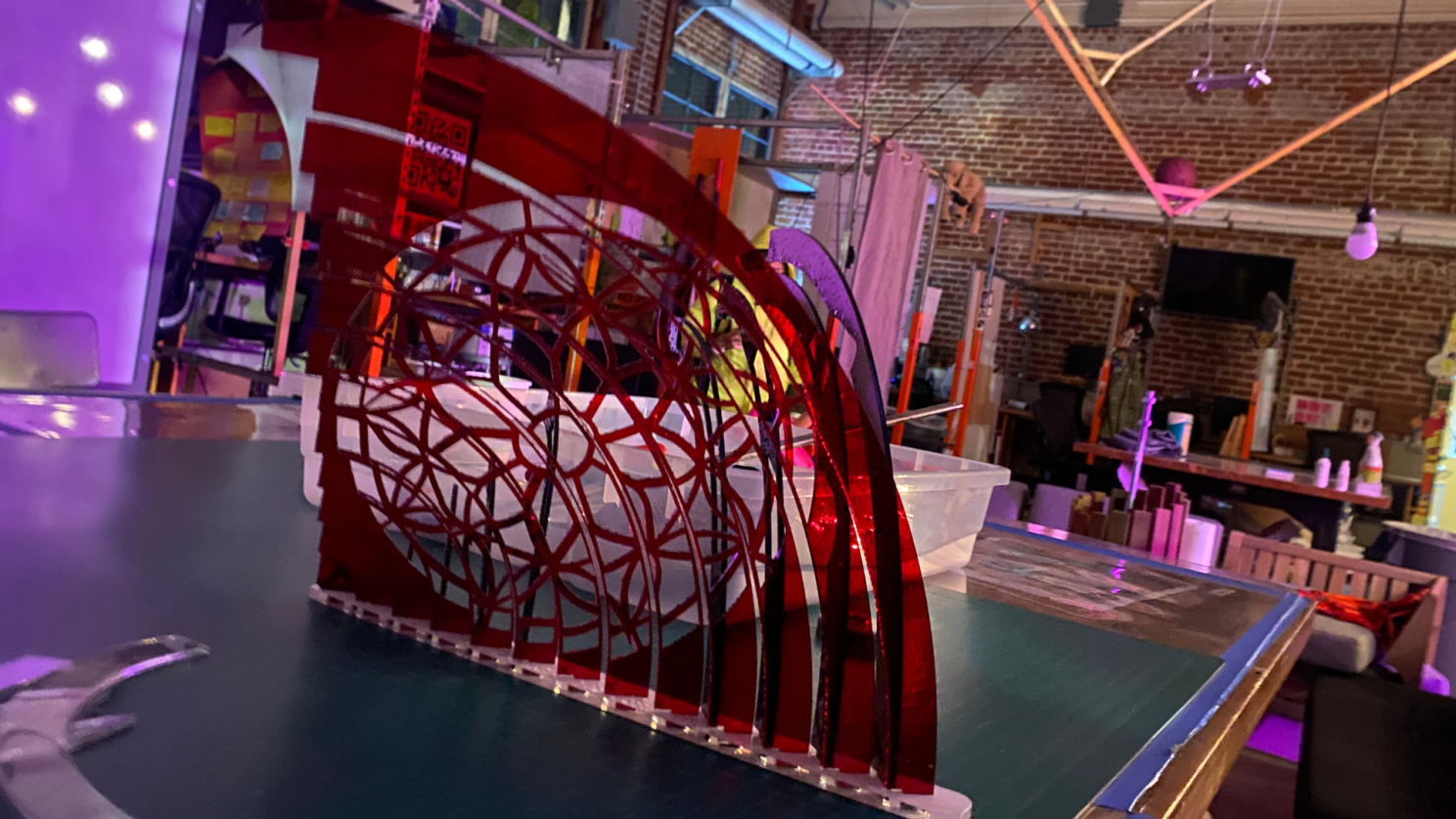
In the winter quarter of my first year, I took Advanced Creative Studies, a class held at David Kelley’s home every week, where students present a creative piece to everyone for critique. For my first project, I wanted to build a 3D sculpture using the laser cutter. One constraint when doing that, of course, is that laser-cut pieces themselves would have a thin side profile; a circle becomes a line if you spin it 90°. If, for example, you cut a square and a circle and attached them perpendicular to each other, on one side you would only be able to see the circle, and if you spin it, you would be revealing the square while the circle turns into a line! The final piece of the effect is dimming the lights in the room, and a focused light source to create an enlarged shadow of the piece on a wall.
Executing this idea took much time to CAD, cut, break, cut again, test with lights, change acrylic colors, play more with geometry, change the light, cut again, and then finally present! I cut 25 arcs that cross each other at a 90° angle, hence naming the project "Arx."
Even though Arx was well received, when I was done, I didn’t think I would tackle something similar to it soon because of how complex it proved to be.
Jumping to the end of my second year, I took a look back at my portfolio and wanted to see which medium I wanted to play with for my Personal Statement. As I flipped through my projects, I looked at “Arx” and thought, “Here we go again”. What that project afforded me was the opportunity to present two sides of a story, my story.
The Build
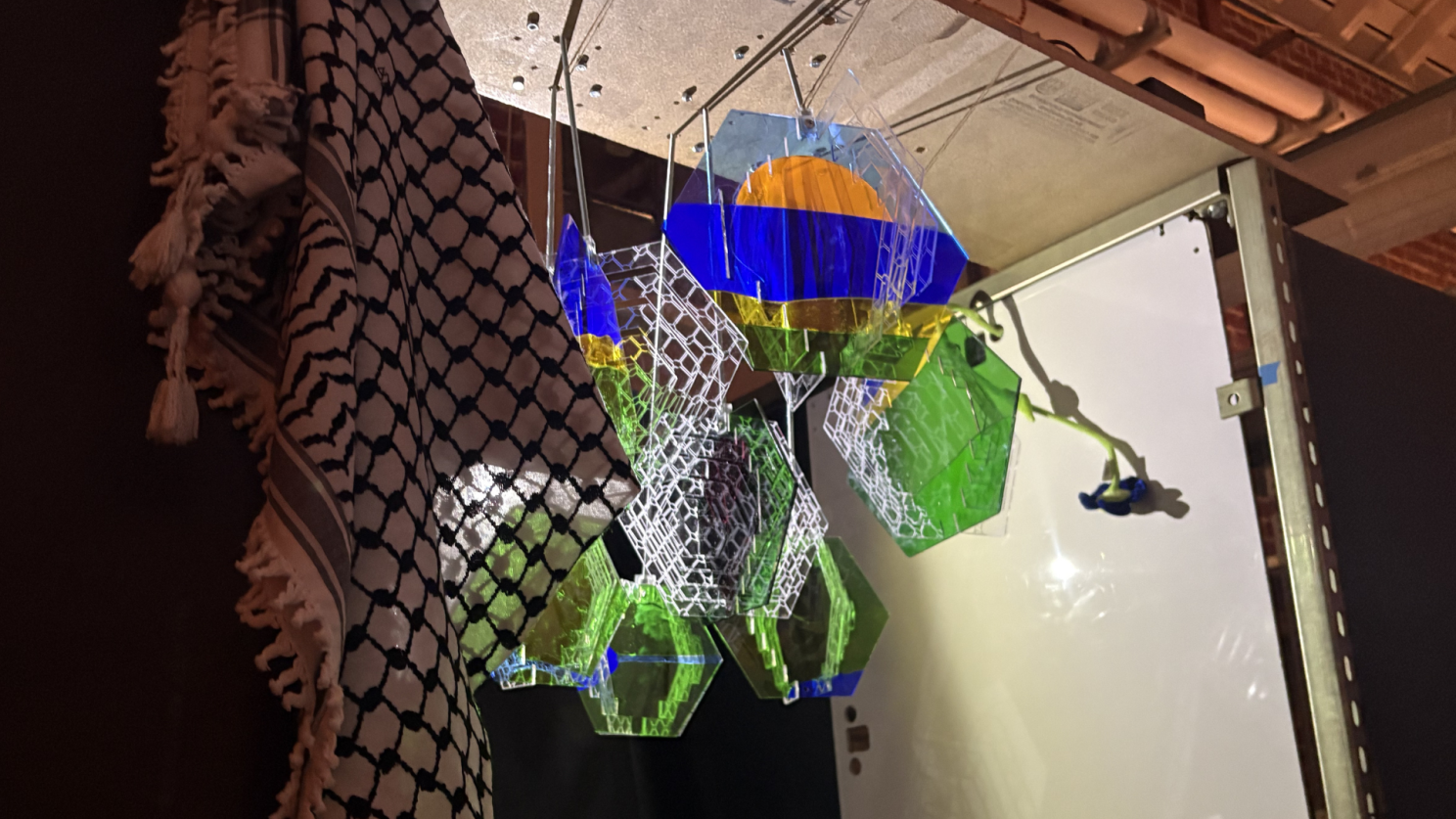
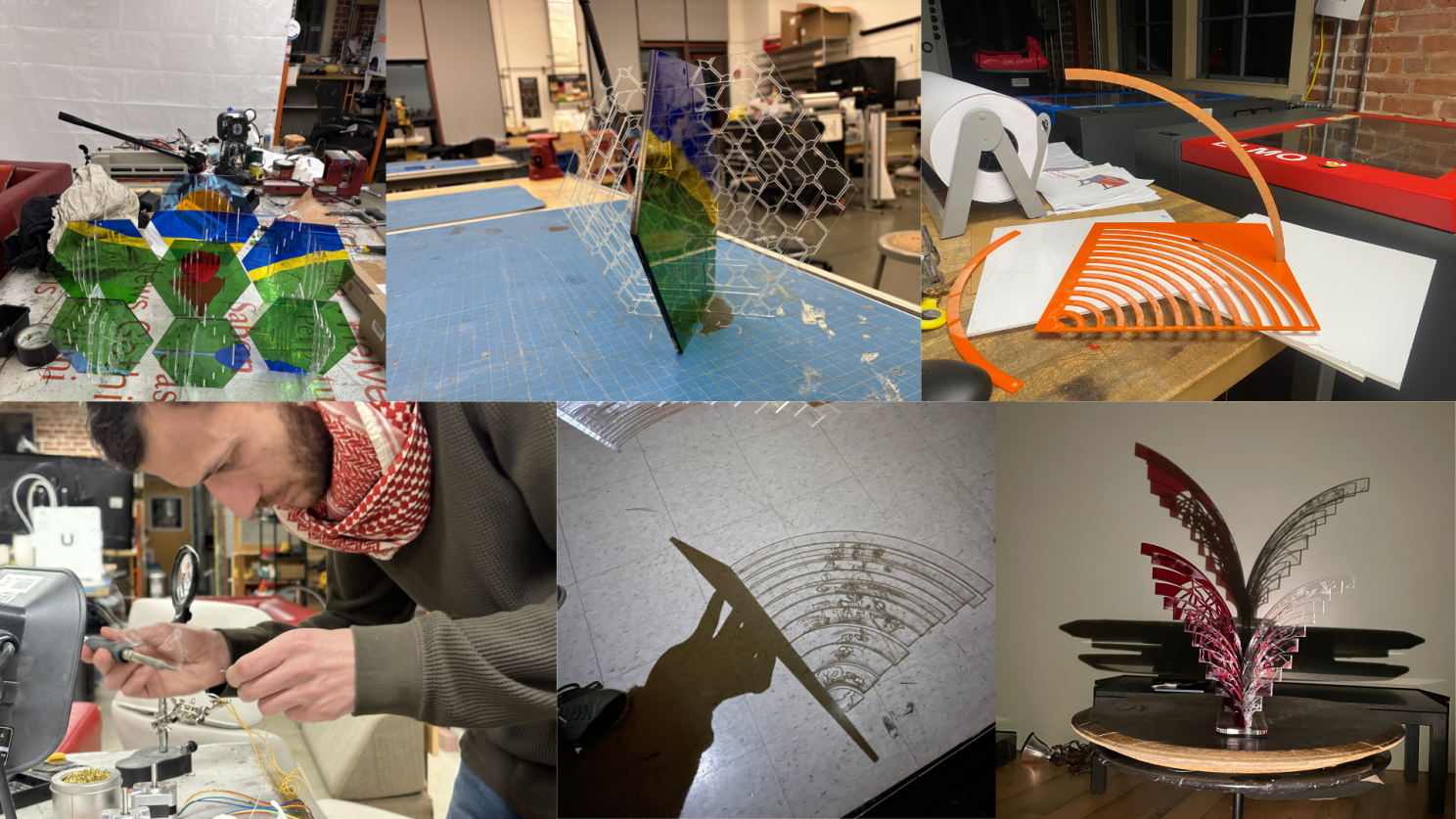
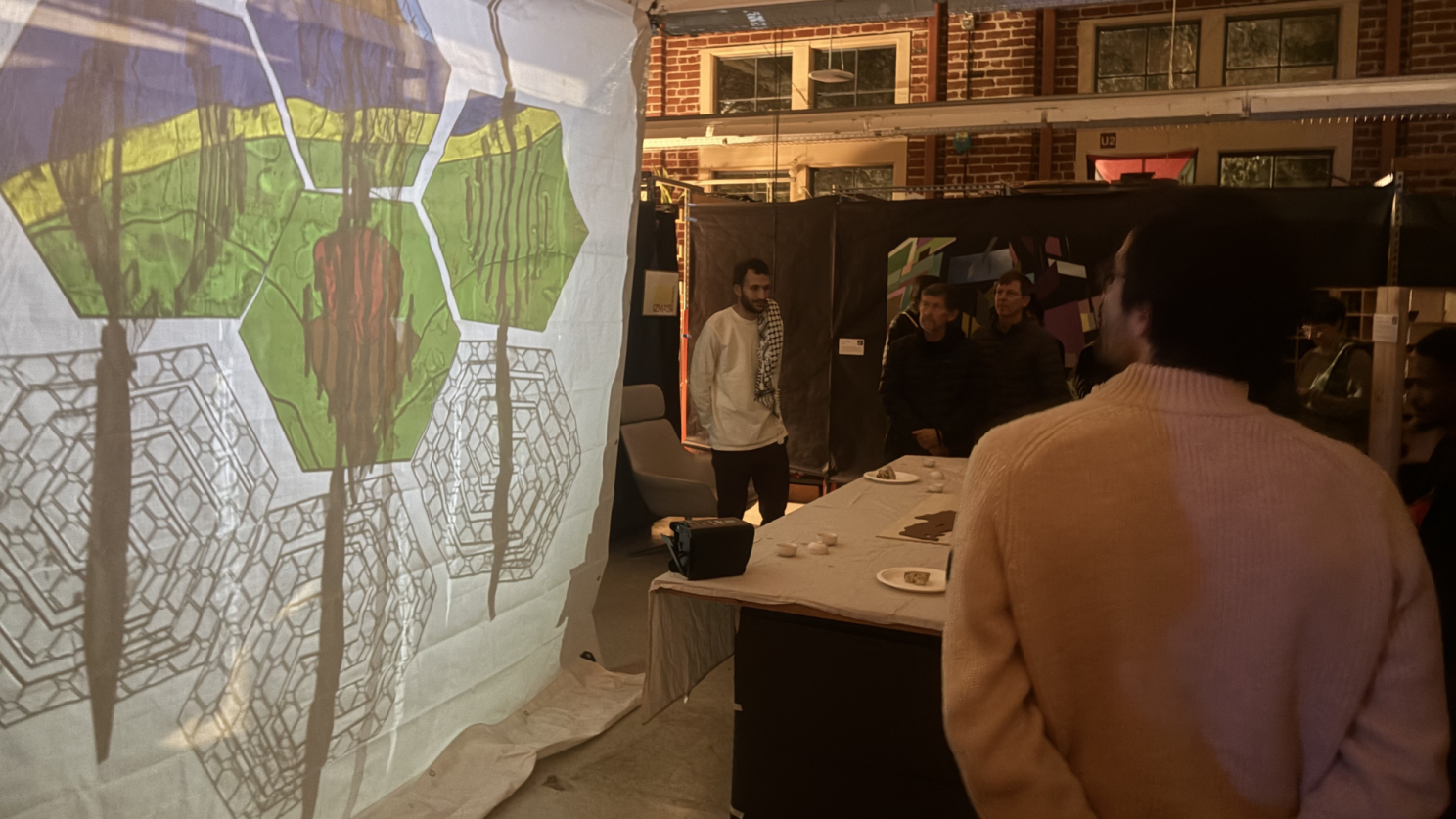
This piece is composed of eight rotating hexagonal sculptures that work together to project a single image. The main design challenge was accounting for optical perspective. Since the sculptures are at different distances from the light, I had to precisely scale each one (the top sculpture is twice as large as the bottom one) and precisely angle them, so that all the shadows they cast appear equal in size.
Building the sculpture involved a mix of digital fabrication and hands-on assembly. The process required:
- Laser-cutting 120 individual pieces of colored acrylic.
- 3D printing seven custom motor bases, each set at a specific angle.
- 3D printing custom holders to connect the sculptures to the motor shaft, and an adjustable mount for the light.
- Assembling and calibrating all the mechanical and electronic components.
Hadil Habashneh (a former Loftee) helped me a lot with gluing the acrylic pieces and assembling everything. She came up with the idea to use rope to hold the pieces at the angle I needed, which worked perfectly. Sanzhar Myrzagalym (first-year Loftee) guided me through the process of using the stepper motors and helped me assemble the electronics. The project wouldn’t have been possible without their help.
Inspiration and Reflection
My grandparents were born in Palestine before 1948, living with a freedom of movement I was never afforded. My grandfather, Shukri Abubaker, was a merchant who traveled freely, breathing Palestine’s air and eating the fruit of its trees. He lived and discovered a Palestine I can only glimpse from afar.
This piece materializes that generational split. One side of the rotating sculpture projects the colorful landscape of his memory. The other projects the Keffiyeh pattern: a symbol of my reality, representing both what is left and the dream of what was.
As viewers step between the light and the projection, their own shadows merge with my story. In that shared space, I wanted them to reflect on how we carry the memories of our ancestors and the weight of inherited histories, tragedies, and hopes.
What's Next?
Now that I've graduated and put a bow on my time at Stanford, I'm more curious and driven than ever. My goal is to turn mundane moments into joyful interactions. I am eager to join a team that achieves this by building thoughtful objects; products that connect with us through their physicality, tactility, and feel.
My work is a continuation of my story, and I would love to share more. For a deeper look at my work and to get in touch, please visit my website: Ahmadab.com