The Creative Shake-Up
• A 10-day challenge to build your practice
This is the d.school’s Creative Shake-Up: A 10-day challenge designed to shift how you move through the world.
This challenge is designed to energize your creative habits, not to produce a finished thing. It’s built on four values that the d.school has distilled as guiding principles for design work: make, care, spark, and adapt.
When you make something, no matter how rough, you turn ideas into action. When you care, you design with intention and responsibility for the people around you. When you spark curiosity, you open space for new perspectives. And when you adapt, you learn from what happens instead of waiting for things to be perfect.
Over 10 days, you're going to trace shadows, rearrange your furniture, write a note to a stranger, and listen (literally) to your own discomfort. None of it will take long. Some of it will feel strange. That's the point. Each day’s challenge takes just a few minutes, though many are worth stretching much longer.
These aren't steps in a process. They're pillars of creative process and habits of mind. And like any habit and all good creative processes, they're built through practice. Small, repeated acts accumulate into something larger than any one of them. Enjoy!
Day 3: Make
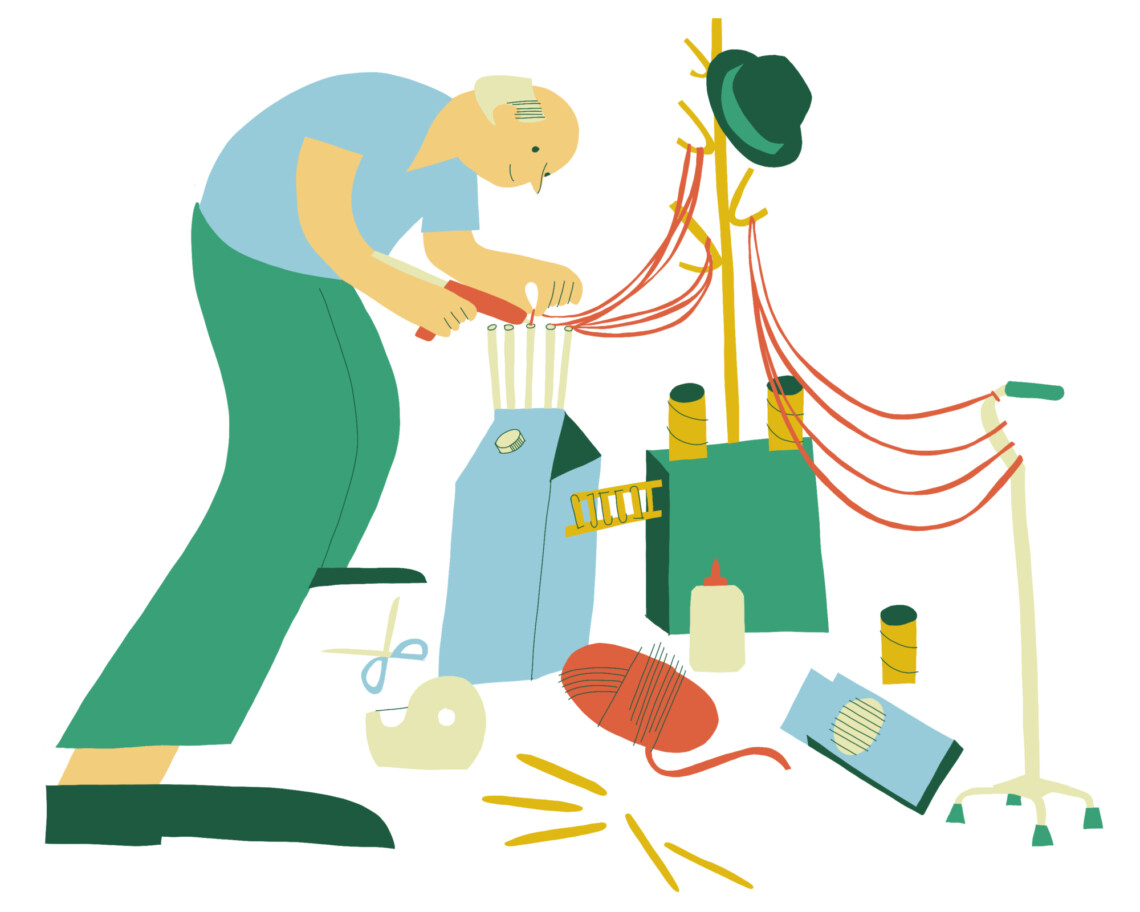
Make (a comeback) by Louie Montoya
Today we’re asking you to revisit an old sweet spot or skill. What did you love when you were younger? What did you study or know a lot about?
Make a list of different forms of creative expression you have used throughout your life, such as writing, drawing, painting, or dancing. Of these activities, which do you still do and which have you dropped? Circle the ones that you haven’t done in a while. Commit to spending at least 20 minutes engaging in one of those activities.
Don’t worry about materials, just get the bare minimum required to do the activity. Work with no expectations of finishing or creating something coherent—just try things out and take action for the sake of doing it. Think of it as visiting an old friend.
How did it feel to revisit this medium? Can you make a habit out of trying old/new things?
Make in design. Working in different mediums can help us access new pathways of thinking and doing. Unfortunately, we often limit our access to one or two that we are comfortable with. But what if we could process information while crafting in a variety of different ways? Being multilingual in how we process information is powerful, and becoming familiar and comfortable with many mediums can be a huge boon.
A note from Louie. I’ve noticed that people tend to use the things they are good at as a crutch. If you found out that you had a natural affinity for drawing or writing, it’s likely that you stuck with those skills throughout your life. We find comfort in what we are good at, but it can constrain our ability to have novel ideas. We become constrained by our own talents and stop growing our eagerness to learn and try new things.
Day 2: Spark

Notice the greens (or blues, yellows, and reds) by Meenu Singh
Take a color walk. Go outside and give yourself 10 minutes of uninterrupted time in nature. It’s best if you do not plan a route or combine it with other activities (commuting, shopping, etc.), but if that’s not possible, fit this exercise in where you can. On your walk, try not to talk or interact with other people. You will not need to bring a phone, journal, or camera, just yourself.
Allow yourself to become sensitized to the color in your surroundings, then let color be your guide. First, select a color, maybe the first color that catches your eye. Now, look for that same color somewhere else and follow it. Let your eyes and your body wander to wherever the color takes you. How many examples of that color can you see?
Next, broaden your view. What other colors reveal themselves more slowly? What colors do you observe that you did not expect? What color relationships do you notice? Do colors appear to change over time? How many shades of one color can you find? Notice what you notice.
Spark in design. “Noticing” is one key for unlocking and finding needs. Through noticing things hidden in plain sight, we find symptoms, clues, connections, evidence of needs, contexts, relationships, and systems. It helps us see opportunity, potential and implicit needs. This activity helps tune your attention to seeing details you might often miss and can help spark your curiosity. Designers are always searching for the nonobvious, and assigning ourselves a nonobvious way to notice can help with that.
A note from Meenu. I started looking for shades of green unconsciously on my drive to work – the morning light is pretty spectacular when it hits the trees, grasses, and shrubs. Now, it’s a delightful way to notice nature and how the hues change hour-to-hour, day-to-day, and season-to-season. When it comes to design work, observation and curiosity are super powers. The ability to notice and be curious about the world around us helps us practice that attunement.
Day 1: Make, Spark, Care & Adapt
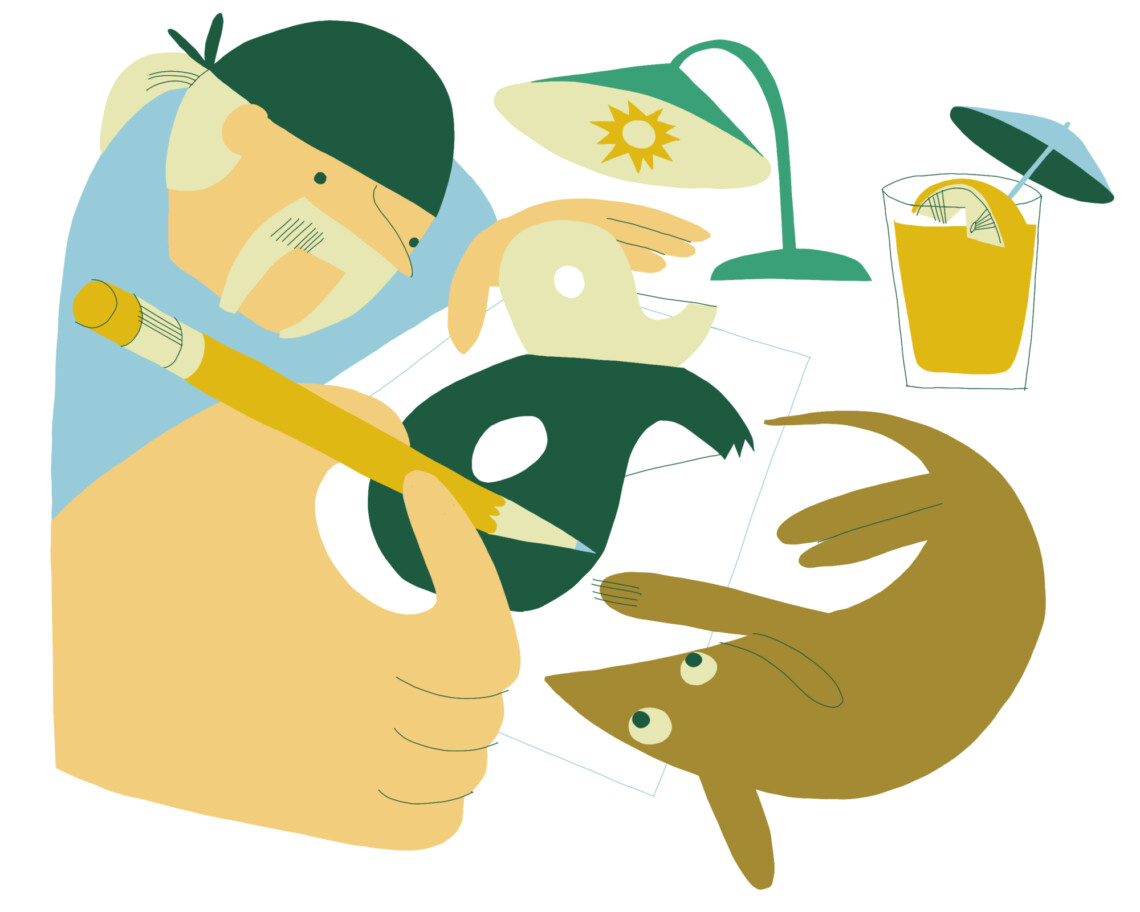
Shadowboxing by Carissa Carter
Your first Creative Challenge requires you to get beyond your head and screen.
Warm up by selecting an object in front of you. It can be close or far away. Hold your arm out and trace its outline with your finger. If it’s close enough to touch, do that. Trace the whole thing. A plant. A chair. A shadow on the floor. Let your hand follow your eye. Do this at least three times, with a different object each time. Go slowly enough to feel the edges and curves.
Next, grab a piece of paper and a pen—any size will do. Select another object and position it on the paper so that light rakes across it at an angle, throwing a shadow. A desk lamp works, as does the sun. Trace the shadow’s edges with your pen. Don’t worry if the shadow is fuzzy or spills off the page. You can even include the object itself if you want. Take your time.
Now, remove the object and examine your drawing. Turn it into something, anything else. You might see a beetle, an alpine forest, your uncle's elbow or . . . Let the shape lead you. Can you keep adding to your drawing for 5 minutes without stopping? Longer? Note, it might be tempting to throw a face on your page and call it done, but see if you can push past that first instinct. Just keep adding marks on the page. Continue to fill out the drawing for as long as you like.
Make, Care, Spark, Adapt in design. Most of us process the world from the neck up. This challenge asks you to bring the rest of yourself along. Tracing with your body slows down perception. You're not just seeing something, you're feeling its shape. Shadow drawing adds another layer. It brings in light as your collaborator and instigator, and the unexpected forms it makes pull you away from what you'd normally choose to draw. It strips common associations and gives you imperfect marks.
A note from Carissa. At the d.school, warming up our bodies and minds through group stokes is common practice. Similarly, in the 1920s at the Bauhaus (the influential German art and design school), Johannes Itten made his students shake out their arms and breathe deeply to prime themselves for creative work. He believed that by activating your body you put yourself into a state of heightened awareness. Even if you’re warmed up though, you may still hesitate to put your first marks on a page. Employing the assistance of light and shadow is a great creative seed.
How it works
Each day offers a new prompt with guided instructions, each requiring a time commitment of 15-20 minutes.
While you’ll do these challenges on your own, we’re also doing this in community. When you’re done each day, share your results and reflections in our LinkedIn Group with other participants and the d.school team.
The Creative Shake-Up has started, but it's not too late to join!
The Shake-Up runs November 2-13, but it's OK to join mid-challenge. Use the registration form below to sign up for daily emails for the remainder of the activity, and catch up on past exercises on this page.
Credits
At the d.school, our design methods are constantly evolving to anticipate the evolving needs of our learners. That’s because our mission isn’t just to teach design, but to accelerate the future of design and prepare our students for the challenges and opportunities of tomorrow. The contributors to the Shake-Up are all members of the d.school’s academic team. They teach courses and work with Stanford students within and beyond the classroom.
(in order of appearance)
Carissa Carter teaches courses in the graduate design program; authored The Secret Language of Maps and co-authored Assembling Tomorrow; and served as the d.school’s Academic Director for 11 years.
Meenu Singh is a lead lecturer in the graduate design program and co-leads the d.school's Teaching & Learning Studio.
Emma Duncan spent two years as a philosophy post-doc and the embedded ethicist at the d.school.
Louie Montoya is a lead lecturer in the undergraduate design program and teaches Design 1.
Glenn Fajardo is a lecturer in the electives program and teaches Negotiation by Design.
Manasa Yeturu is a lecturer and undergraduate social impact domain lead.
Leticia Britos Cavagnaro teaches graduate design courses and co-leads the d.school's Teaching & Learning Studio.
Illustrations by Elissa Turnbull.
Thanks to Mark Grundberg & Jenn Brown for producing this content, and to Laurie Moore, David Martinez, Amanda Tiet, and Ellie Kimmes for their expertise in sharing this work.
LICENSE: CREATIVE COMMONS ATTRIBUTION-NONCOMMERCIAL-SHAREALIKE 4.0 INTERNATIONAL


