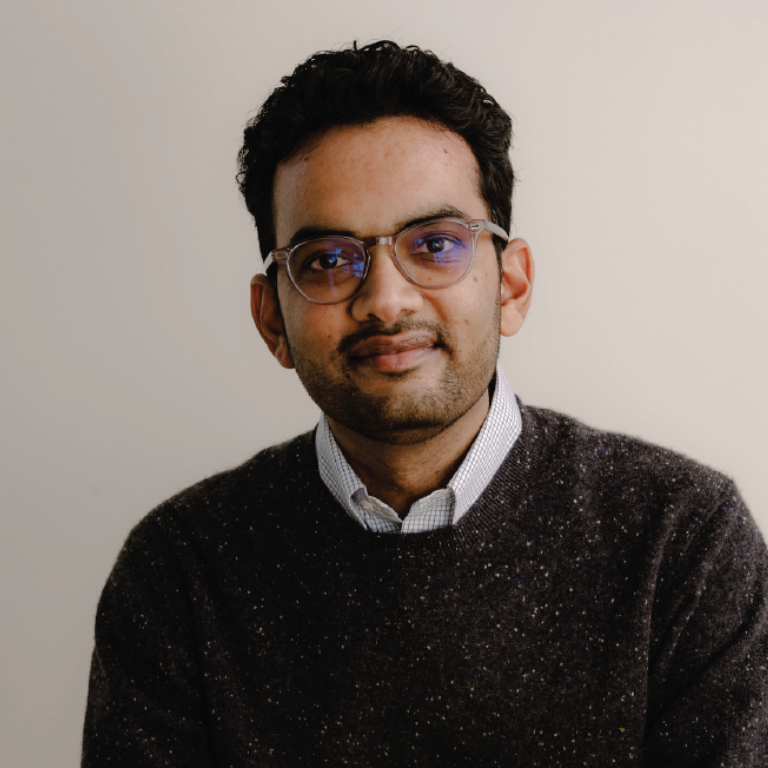
For Akshay, the d.school was a magical place full of rolling whiteboards, a big open space, and a sense of fun. It was also where he co-created Pulse, a news app that was later acquired by LinkedIn. During his two years at Stanford, the d.school was where Akshay was able to reignite his creative confidence.

A different design path
Akshay got his master’s in electrical engineering from Stanford, but says he was a “really weird student.” He self-funded his Stanford education, which allowed him to take the road less traveled: opting to learn from the music school, mechanical engineering, computer science, and of course, the d.school. “I was there fully for curiosity and exploration and less trying to do well academically and care about my GPA.”
“I’m a product of the d.school in a big way because I was very much an electrical engineer, sitting in labs with very low confidence that I could go build things myself,” said Akshay. “The concept of design thinking definitely gave me the creative confidence to feel like, ‘Oh, I could go build things, too. I could build things that customers would love.’”
Studying in these spaces allowed Akshay to meet and work with diverse teams and perspectives, and push himself out of his comfort zone. “Being surrounded by journalists, business students, and good designers has made me appreciate that function is not enough. To really stand out and to make a mark in this world, you have to combine it with form.”
A finger on the pulse
During his two years at Stanford, Akshay said he tried (and failed many times) to create projects every quarter that he hoped would become a startup. In his final quarter, during the d.school's Launchpad course, he and co-founder Ankit Gupta created the mobile news aggregation app Pulse, which they built and released in six weeks. The app was later acquired by LinkedIn.
That leap of faith led to a starstruck moment when Steve Jobs spoke about their app during the Worldwide Developer Conference. “The first app he talked about was Pulse. I just couldn’t believe it. It felt like one of those moments where you’re pinching yourself to see whether that was a dream or not.”
One of the lasting lessons from building Pulse was staying close to customers and getting feedback—a major evolution from when Akshay was nervous to ask for interviews. By his final quarter, he was confidently asking strangers at cafes for comments.
“I still don’t have any formal design education, but I think something about being surrounded by people who have such good taste has rubbed off on me,” mused Akshay. “I’m a little bit more knowledgeable about design and I feel like I have deep appreciation for the craft that is required to build something that evokes good emotions in people.”
Feeling good
“Design is how you feel, how it makes you feel. Like some connection to human emotion,” said Akshay.
Even now, he lights up when he thinks about building a product. “I just love building and that thrill of getting something out into our customers’ hands. I feel like my zone of genius is very much the intersection of product and business, that’s what I enjoy.”
When he co-founded Notion in 2013, one of their primary inspirations was Lego blocks and the ability to create anything from them. And that combined with his thoughts on making a positive experience for users and a real feeling of delight.
Akshay, who also serves as their head of product, asked, “What if we broke down the software we use to its building blocks and give it to the people? Would we unleash this creativity where people can put these building blocks together to create their own software?”
And while he says Notion isn’t directly solving all the world’s problems, it provides a space for people to collaborate better—which means they could play a part.
“We’re not building vaccines, but during Covid, a lot of medical companies used us to collaborate. We’re not solving the climate, but a lot of climate change companies use us to collaborate and build products. It’s a second-degree impact that is much more interesting.”
Agency and action
One major takeaway: try, try, try again. Akshay’s breakthrough success with Pulse was the culmination of his different attempts at projects and all the lessons he’d learned at the d.school.
His advice to his younger self was to “reduce the scope and sweat the details. Make sure the quality is high.” That focus contributes to Notion’s success—going the extra mile to make it feel delightful.
“I feel like Stanford taught me how to have agency and go do things rather than just sit and think about it,” said Akshay. “Bias towards action is so important in this world. With AI, where the world is going to change so much, I think the people who survive are the people who have agency.”
Credits
Thanks to Tran Ha and Amalia Rothschild for originally interviewing Akshay for the d.school’s “This Is Design Work” exhibition; Mark Grundberg for shaping the interview content; Second Peninsula for producing the video; the d.school’s academic team and teachers for guiding generations of designers; Eli Ramos for writing this article; and Jenn Brown for her persistently collaborative editing.