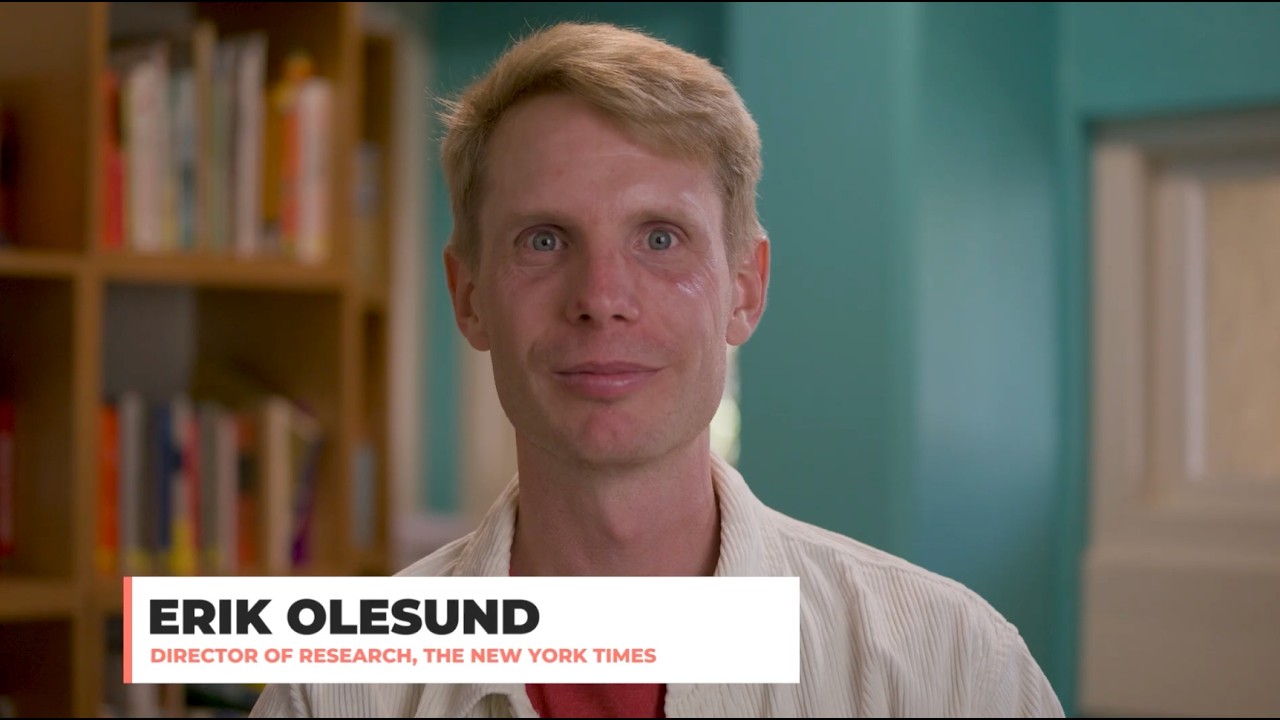
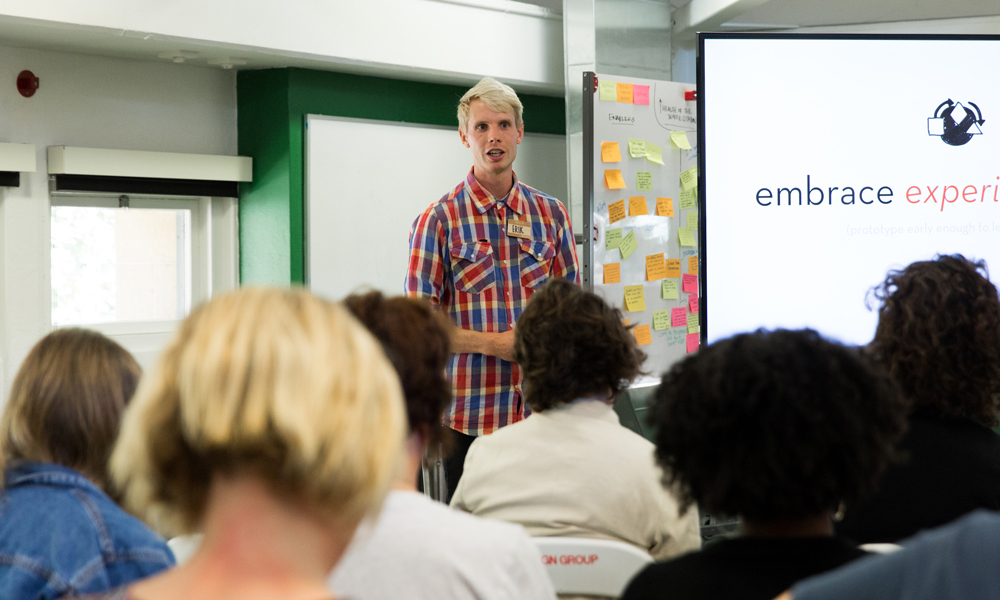
Erik Olesund's job at The New York Times isn’t just about getting results, it’s about understanding people and what they need—something he learned at the d.school.
An invitation to play
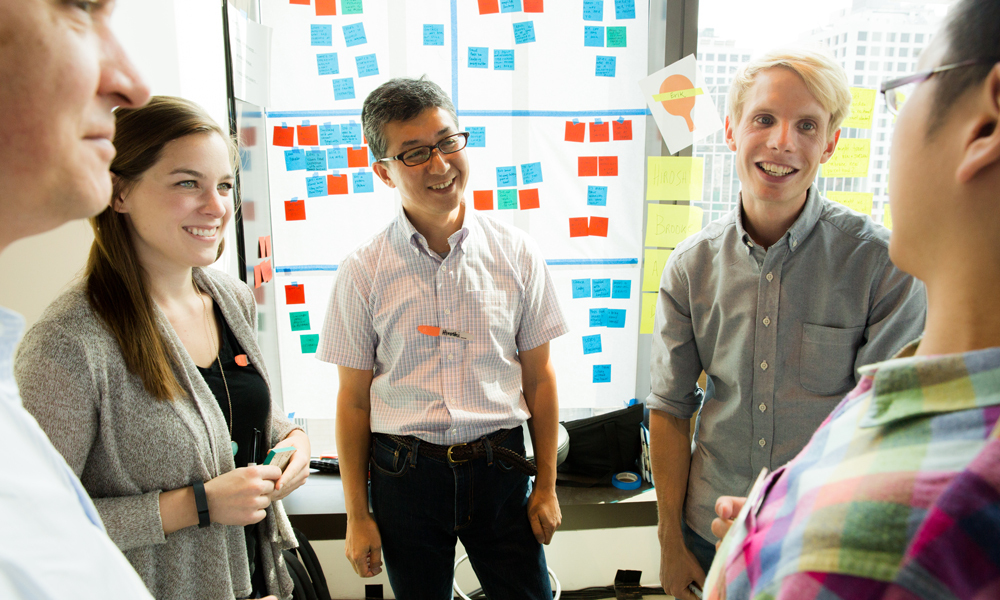
Erik initially studied systems analysis as a graduate student, but decided to pursue design after being a tester for a class in the d.school. “It looked like no other room I'd been in at Stanford, and I immediately felt like I needed to also take a class where you got to play like they did,” he said.
He especially felt invited by Debra Dunn and Matt Rothe, who helped to nurture his potential, welcoming him and teaching him to look at problems in a human-centered way. “There’s a joy and richness in small-scale data, looking deeply into people’s lives,” said Erik.
At the same time, he also started doing improv, which he still does today with the Polite Society Players. Erik says that he uses the same skills as an improviser and a designer. “No company, situation, or week is ever the same. To be successful in my work is to understand what the team wants to accomplish, where the puzzle pieces I can contribute will fit in, and to not do the same thing all the time.”
His ability to play within the d.school gave him opportunities to be curious, collaborative, and have fun. It also gave him a way to reframe questions to solve problems, and “get to the essence of the uncertainty.” Rather than seeking generic feedback on a design, Erik connects it to the behaviors of people and to company goals, which helps to point his team in a clear direction.
Shifting focus
Erik said that he wasn’t sure what to do after his time at the d.school, but he chose to seek out practical experiences through freelancing. “So much of the things that you need to learn will not come to you by reading or researching or thinking, but by doing,” said Erik.
Erik worked at Thumbtack as a head of the user experience research team, where he and another freelancer did a deep ethnographic study on caring for and improving homes. Their work compelled the company to focus on homeowners. Then, he worked as a research lead at Instagram on redesigning their native video editor to be slightly more advanced, but a lot easier to use.
“There was a ton of resistance to that idea,” said Erik. “We had to be very creative with our research and exploration. When the initial set of data wasn’t enough to convince senior leaders that this was the right choice, we kept at it, doing new studies to prove it. It was really fun to see that come to life.”
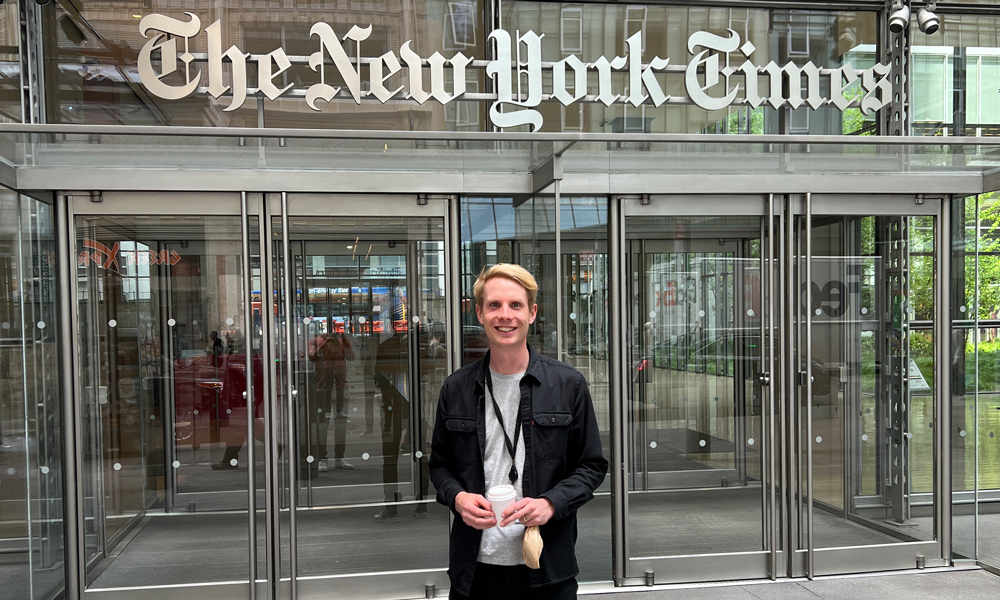
Finally, he landed with The New York Times where, as their Audience Research Director, he’s currently working on understanding how their audience engages with the news so they can create intuitive experiences. “I’m proud of this work because I get to be part of a change in this company, to meet people where they are. It’s revealing many insights that have very clear implications of what we do next . . . and we actually have to change what we’re doing. It feels exciting and fun to rally people behind these ideas.”
Making change
Erik says that the biggest impacts come from either strategic or evaluative design. “I enjoy the evaluative because I know once we get here, we make direct decisions based on research,” he said. To Erik, this approach feels more immediate and meaningful, and different from strategic work which tends to lead to impact far later down the line.
But his research doesn’t always find clear answers. “It’s oftentimes my job to accept the question and guide the team away from having to answer it. We might need to make a decision or reason our way through,” he said. “The questions we answer are the ones that unlock a key datapoint or key uncertainty you need to address. I try to shape those conversations into addressing what’s preventing us from moving ahead or blocking us from making a decision.”
For young designers, Erik recommends building skills early, sampling more specific roles, and having demonstrable skills. And for those who aren’t sure about design?
“Just try it. The d.school is where I found my passion for work. There you get to try all kinds of ways to make, and I'm sure there's gonna be one that sticks for you.”
“The most important role that design education can play in preparing students for future and for their work is by giving them a ton of opportunity to make,” said Erik. “By making mistakes, making products,” Erik says, “the next generation of designers can make their own path.”
Credits
Thanks to Tran Ha and Amalia Rothschild for originally interviewing Erik for the d.school’s “This Is Design Work” exhibition; Mark Grundberg for shaping the interview content; Second Peninsula for producing the video; the d.school’s academic team and teachers for guiding generations of designers; Eli Ramos for writing this article; and Jenn Brown for her persistently collaborative editing. The New York Times photo courtesy of Erik Olesund; other photos credit Patrick Beaudouin.