In classrooms across the country, students are navigating systems that weren’t built for them—especially Black, Brown, low-income, and other historically marginalized youth. Yet, time and again, we’ve seen how creativity and confidence emerge when students are invited to see the world—and themselves—differently.
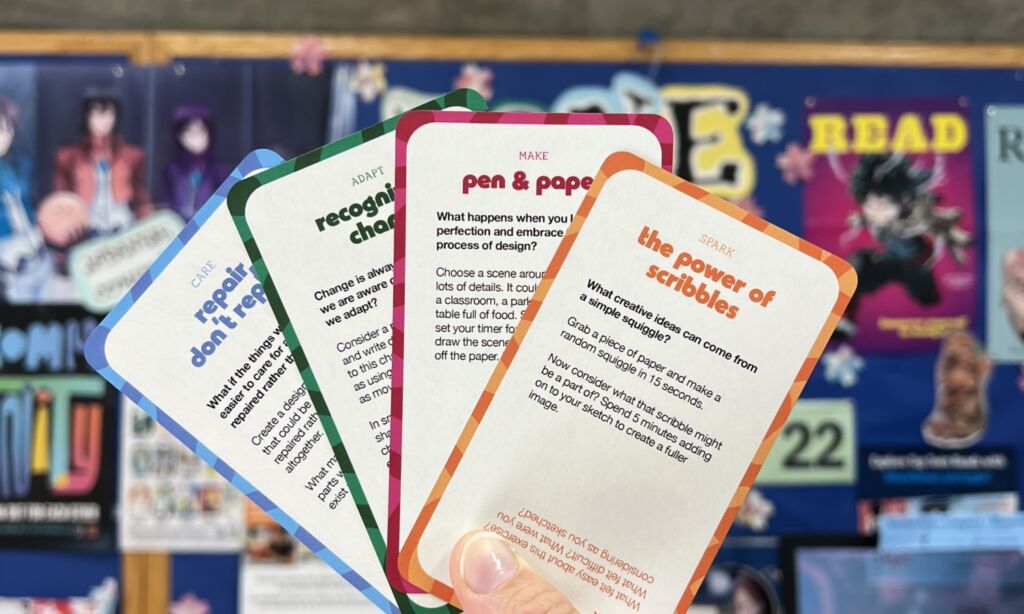
The Deck of Design Values is an invitation to think differently. Designed as a tool for educators, this resource is grounded in the belief that young people are already powerful problem-solvers, designers, and visionaries. This deck is full of flexible, joy-inspiring activities that encourage creative problem-solving and reframe constraint as possibility.
Divided into four categories, the Deck of Design Values promotes different types of skills: Make cards exercise creativity. Care cards build empathy and curiosity. Spark cards prompt playful thinking. Adapt cards deepen contemplation. Each card offers an inquiry, a short exploration, and a reflective question.
Whether you're teaching STEM, History, English Language Arts, Math, or guiding creative work in an art space, these cards are designed to spark agency, perspective-shifting, and joyful engagement—especially valuable for students who haven’t always seen themselves reflected in traditional learning environments.
Every deck you purchase directly supports equitable access to liberatory learning tools—because for every deck sold, we send a free one to a classroom serving Black, Brown, Indigenous, immigrant, or low-income students. Your purchase not only brings powerful, youth-centered design tools into your own practice—it helps ensure that educators in under-resourced communities receive the same opportunity to spark creativity, confidence, and agency in their students. It’s a simple but impactful way to invest in collective empowerment.
This deck was created in collaboration with Amplifier, a nonprofit media lab that builds campaigns to amplify the most important of our times.
Credits
Written by Stanford design students Camdyn Grace Doucet, Mayahuel Gutierrez Malik, and Danna Lenis-Granada, with contributions from d.school faculty Carissa Carter and Louie Montoya, and Stanford design graduate Katrina Liou. Special thanks to Emily Goulding.
Illustrations by Nina Yagual.
Published by Amplifier.