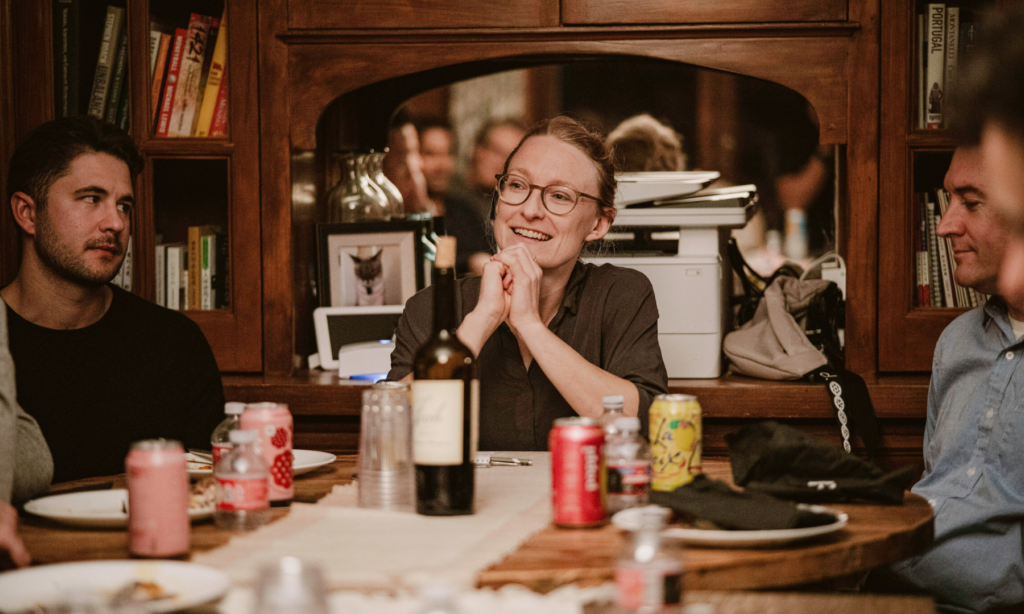
At the d.school, there are many ways to explore design methods and mindsets. In the class Psychedelic Medicine x Design, instructor Elysa Fenenbock leads students into a design space that cuts across mental health and wellness, policy, business, technology, indigenous wisdom, culture, art, nature, plant medicines, and people. In this article, Elysa uncovers the complexity of design that is particular to psychedelic medicine.
What Design Has to Do With Medicine
For the past few years, I've taught Psychedelic Medicine x Design at the Stanford d.school. Every time I mention it, I get the same questions. Design? What kind of design do you mean? Do you mean designing visuals for a trip? Do you mean taking psychedelics to become more creative?
Not quite. Though those are interesting too.
When I say design, I mean:
- Creating systems that facilitate healing—not merely substances.
- Creating spaces that facilitate transformation—beyond the clinical room.
- Creating touchpoints that signal safety and calm the parasympathetic nervous system.
- Creating experiences that are trauma-informed, inclusive, and integrative.
- Creating infrastructure that connects patients, practitioners, and policy—with dignity.
Design is a tool that can help get psychedelic medicine right.
Not design as decoration but design as a practice of care. Design that learns from existing practices, both indigenous and clinical. Design that integrates deep empathy and systems thinking. Design that actually shows care, not just claims to.
The lessons from psychedelic medicine apply to all of healthcare. Every healing space is human-centric. Every patient is vulnerable in their own way. Every medical experience shapes not just physical outcomes, but psychological and emotional ones.
From emergency rooms to oncology wards, from primary care clinics to psychiatric hospitals, we can redesign healthcare to honor human dignity, support nervous system regulation, and recognize that the space and experience itself is part of the medicine.

Design as a Practice of Care
The psychedelic medicine space isn't being forced to get design right from the beginning. And that’s why we’re looking at it.
Indigenous cultures have stewarded relationships with psychoactive plant medicines for millennia and, amid today’s mental-health crisis, these practices are re-entering public consciousness. A massive proportion of the population is suffering from acute and long-term mental health issues that psychedelics are showing incredible promise to help.
Michael Pollan’s book How to Change Your Mind helped bring psychedelics into the mainstream cultural conversation, while parallel waves of renewed scientific research have demonstrated promise across conditions including PTSD, depression, traumatic brain injury, and end-of-life distress. As of this writing, more than half of U.S. states have active legislation spanning clinical trials, therapeutic access, and decriminalization or reduced penalties for use—signaling a rapid shift from a fringe practice toward formal systems of care, with veterans, postpartum mothers, and professional athletes among those engaging these therapies. And with an April 2026 executive order easing restrictions on psychedelic substances and accelerating research and access to treatment, the call for better systems and care design is more urgent than ever.
Designing for psychedelic medicine—at the d.school and beyond—is designing for healthcare. But here's what makes this different from other medical fields: psychedelics are an incredibly human-centric medicine. The patient experience isn't incidental to the treatment but inextricably linked to the treatment. To get this right, we need to show incredible care with the psyches of vulnerable populations who are already in crisis.
Designing for psychedelic medicine is also designing beyond healthcare. With a truly human-centered lens, psychedelic medicine has tremendous potential for models of community care outside of the medical spaces.

Designing for Altered States
One of the central challenges of designing for psychedelic medicine lies in how altered states of consciousness are held. While some contemporary research questions whether the psychoactive experience itself is necessary for healing, ancient and Indigenous traditions have long understood altered states as integral to transformation. Western culture remains relatively unpracticed in intentionally designing environments that support people through non-ordinary states, particularly when those experiences intersect with mental health vulnerability.
When designing for psychedelic medicine, we can learn from how other fields have designed for vulnerability, transformation, and altered states. The most powerful examples of intentional design come from spaces designed for life's most profound transitions: birth and death. These aren't just examples of good design—they're examples of analogous design. Analogous design means looking at similar problems in different contexts to find solutions. Birth and death are threshold experiences—moments when we cross from one state of being to another, when we're at our most vulnerable, when we need to feel both safe and supported through something we cannot control. What makes these spaces work is not a single kind of expertise, but layered expertise. Medical professionals attend to physical safety and risk, while doulas, hospice workers, and spiritual caregivers hold the emotional, relational, and existential dimensions of the experience—each form of knowledge is essential, none sufficient on its own.
Consider birthing centers that bridge medical safety and human comfort. They understand that some mothers feel safest at home, while others feel safest in clinical settings. The design honors both—medical equipment is present but not dominating, spaces feel cozy without compromising care, mothers have agency over their environment during one of life's most vulnerable moments.
Or consider the San Francisco Zen Hospice Center, which has long been a model for redesigning end-of-life care to honor dignity, presence, and humanity. When BJ Miller, palliative care physician and co-founder of Mettle Health, came to class alongside Ladybird Morgan, palliative care nurse/educator and co-founder of The Humane Prison Hospice Project, they shared a ritual practiced at Zen Hospice: when someone dies, anyone present—staff, family, visitors—can pause and offer flower petals as the body is carried out. Petals are gently placed over the person, marking the transition with beauty, reverence, and collective witnessing. It’s a small gesture, but a powerful one. Medical care remains present, yet the experience says something essential: you are seen, you are loved, you matter.
These spaces understand a critical design truth: birth and death were once held at home, in community. As they’ve moved into institutional settings, the challenge is in designing them in ways that preserve humanity while meeting clinical needs. This is the parallel to psychedelic medicine. Traditionally, these medicines were held within community, ceremony, and carefully designed sacred spaces shaped by generations of lived practice. As they move into Western systems of care, experiences must be designed in dialogue with this deep experiential wisdom—while also meeting what contemporary patient populations need to feel safe, supported, and respected.
Human-centered design gives us the tools to imagine new kinds of blueprints, test them in the real world, and continually refine care environments based on lived patient experience. In psychedelic medicine, this also means learning how to integrate multiple forms of expertise—clinical, cultural, and ceremonial—into systems capable of holding people through profound and uncertain states.

The Ibogaine Challenge: Designing for Radical Possibility
I’ve taught Psychedelic Medicine x Design at the Stanford d.school for a few years now. Last year I changed how I teach the course. I still used a layered, human-centered design approach, but had students tackle real-world design challenges for organizations like MAPS, Ancestral Heart, and The Shulgin Foundation. These were great experiences, but solutions often stayed trapped in what's already possible, already fundable, already safe.
This past year I gave students a different brief: DESIGN FOR THE FUTURES YOU WANT TO SEE.
We explored ibogaine—one of the most complex challenges in psychedelic medicine.
Ibogaine holds powerful promise for treating addiction, PTSD, and brain injury. But its 24-48 hour journeys, serious medical risks, and sacred roots in the Bwiti tradition of Gabon make it one of the most complex medicines to deliver. With Texas making huge investments in ibogaine research, the moment is ripe—but also risky.
In the course, students learned from two guest experts initiated in the Bwiti tradition—Tricia Eastman, initiated medicine practitioner, and Joseph Barsuglia, PhD, clinical psychologist—who together modeled how ancient ceremonial knowledge and Western clinical practice can coexist. Designing responsibly for ibogaine requires understanding how these traditions have safely held the medicine, and how they have supported initiates through the altered-state experience itself.
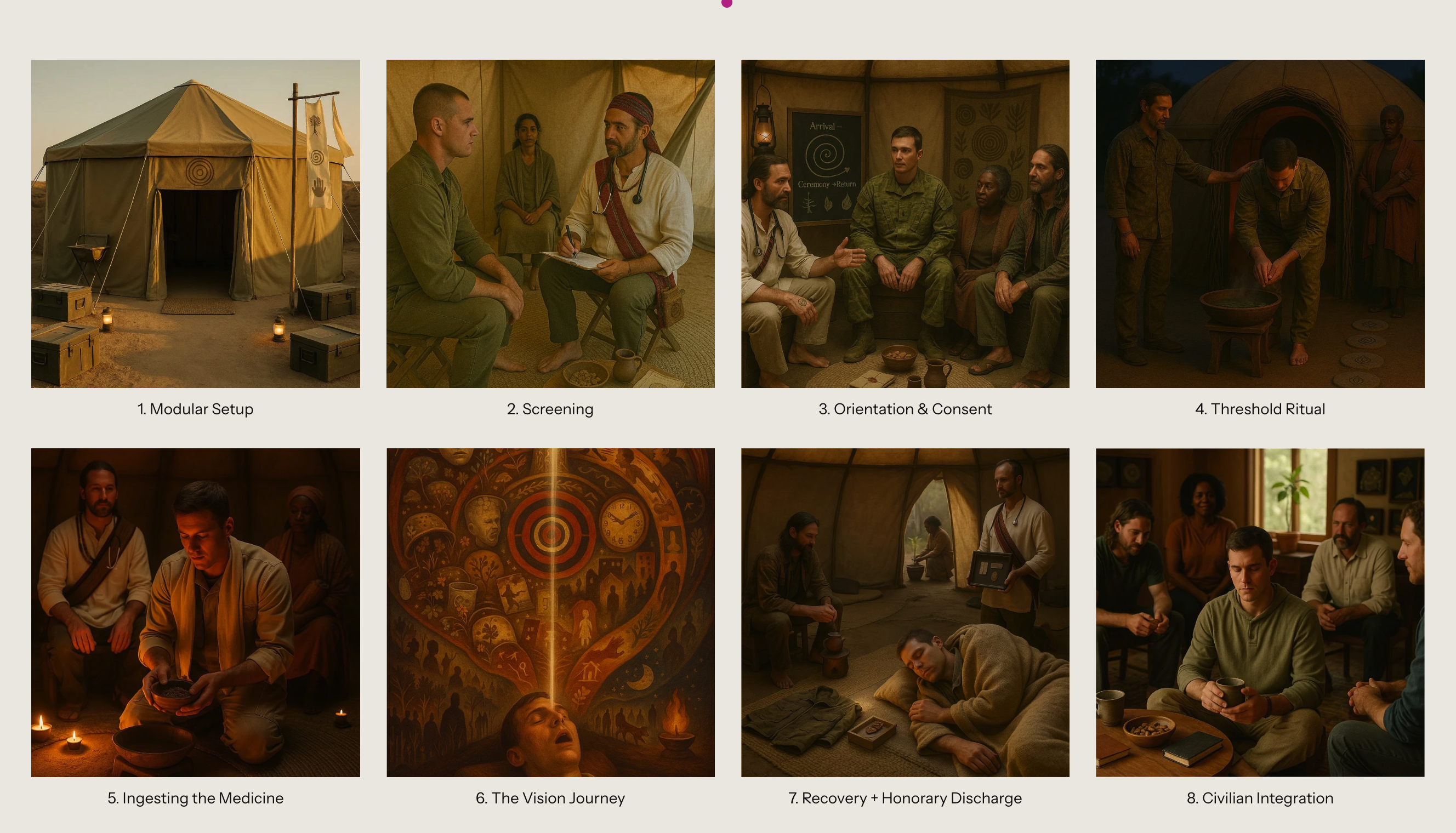
Given this new design brief, here's what happened: With just one in-depth lecture on ibogaine, expert input from practitioners in the field, and a foundation in design, students produced work that blew away those very same experts. Decades-long specialists in psychedelic medicine took the student work as early inspiration to share with partners at the US Department of Health and Human Services and with the Colorado Board of Natural medicines to help them determine if they would move forward with their program for a state ibogaine.
Think about that for a moment. One lecture. The right context. Expert collaboration. A design approach. And students were able to generate powerful concepts that seasoned professionals wanted to take to federal and state health agencies.
While the work was conceptual and not entirely realistic—an early prototype, after all—it nailed the visual, emotional, and experiential complexity of the system. The students demonstrated the power of rapid prototyping, empathetic understanding, and futures thinking.
Their design balanced reciprocity and right relationship with indigenous practice—honoring the historic experts and guides of these medicines—while integrating Western clinical oversight for one of the most complex and potentially dangerous psychedelic medicines in the world.
Students explored how speculative and experiential design can bridge science, culture, and care to build ethical, inclusive systems that honor both safety and sacred traditions. Ibogaine is an extreme case, but it makes the larger point clear: the future of psychedelic medicine will be shaped not just by what we study or legalize, but by how intentionally we design the systems that hold people through transformation.
Psychedelics expand consciousness. Design expands possibilities.
When we bring rigorous design tools, processes, and expertise into psychedelic medicine, we create space for radically different futures of care—ones that can hold complexity, honor layered wisdom, and respond to real human vulnerability. This work is deeply interdisciplinary, and its potential depends on who we invite into the conversation.
To hear more from Elysa, visit her substack.
Credits
What happens in here can feel like its own little bubble. Thank you to Patrick Beaudouin, whose snapshots capture the moments our perspectives shift, and to Jenn Brown, whose patience and clarity helped us stretch that bubble wide enough to share.