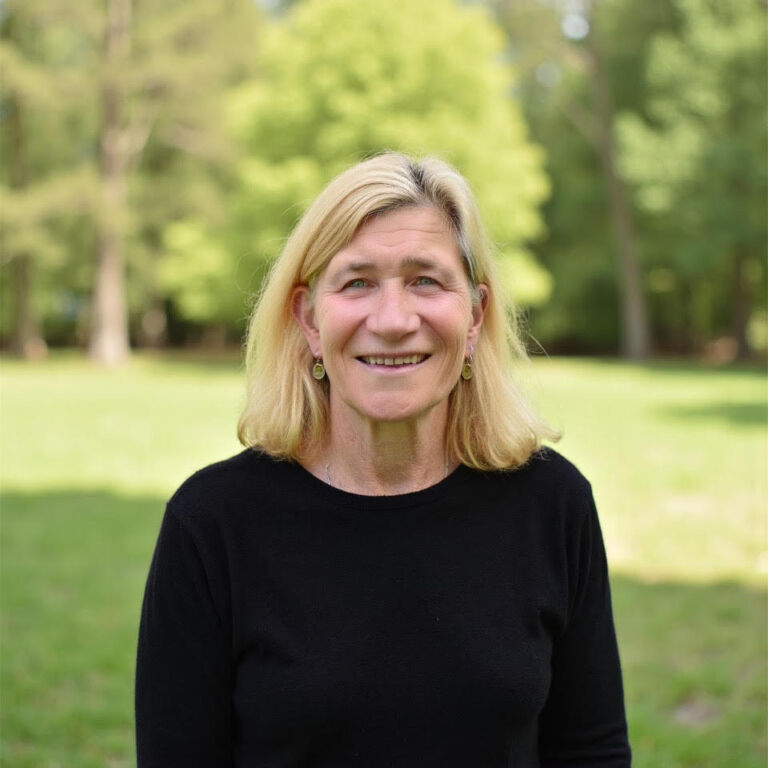
Jill Vialet has come full circle with the d.school: once a K12 fellow, she is currently the d.school’s interim Academic Director, applying her decades of experience in organizational design and creative problem-solving to the d.school’s leadership transition.
Throughout her career Jill has founded three nonprofits, including Playworks, an organization that brings structured play to schools nationwide. Through the d.school’s K12 fellowship Jill learned about human-centered design and launched the nonprofit Substantial Classrooms. “To me, design is problem solving. And one of the things my time at the d.school taught me was the invitation to flare,” said Jill. That approach — expanding your thinking — is the opposite of a scarcity mindset, which Jill says is common in the nonprofit world. “People ask, ‘Can you just tell me the answer?’ and I say, ‘No, no, no. I’m going to take you through this process to deeply understand so that we can solve this problem.’”

Connection and play
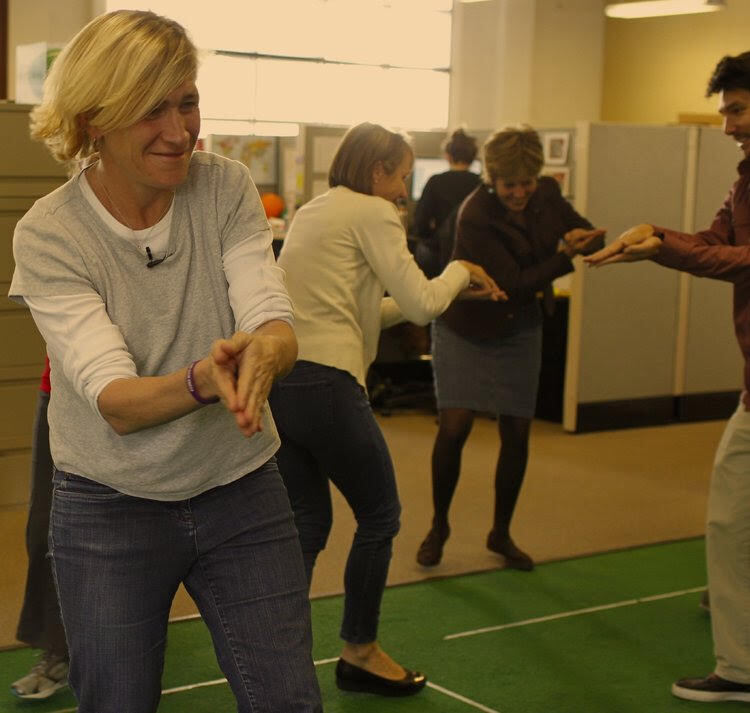
Having founded Playworks, Jill values play as a whole. “It’s a foundational experience of problem solving and design,” she said. She came to the d.school through the Design for Social Change Fellowship and credits Susie Wise, the founder and former director of the d.school’s K12 Lab, for inspiring, mentoring, and teaching her.
“It was great to learn by doing, and there was a sense of connection with the other fellows,” mused Jill. “That style of learning was so rich.” She brought play into her learning experience, which she connected with human-centered design—a connection she’s taken everywhere she’s worked.
While at the d.school, Jill also worked on what would become Substantial Classrooms, where she and her co-founder worked on bringing organizational design to professional development for substitute teachers. “We were very intentional emerging from the d.school. We brought a fun aspect, because substitute teaching can be pretty grim.”
Start ups and starting over
Jill progressed with Substantial Classrooms, and its online professional development program SubSchool, as well as Playworks—both of which benefited from her experiences at the d.school.
While SubSchool earned rave reviews, scaling was challenging because school district purchasing dynamics halted its progress. “We realized we needed to find a larger organization to take up the product.” Their unusual solution? They were acquired by national nonprofit Grow Your Own. “It did involve us being more expansive in our thinking,” said Jill. “To design a path forward for the project, we had to focus on the outcome we seek versus the output.”
Playworks was hit badly during the pandemic, requiring massive layoffs. “I felt like I was designing how we recover from this process,” said Jill. She decided to include herself in those layoffs. “That was the way to design it to send the message that this was an existential event.”
Having started three different organizations, Jill has honed her perspective on designing. “Being immersed in design is being mindful of when you’re focusing and when you’re flaring. There were moments that called for great intentionality.” Overall, she believes that intention should drive great design.
Transitional leadership
Jill is no stranger to change—she was recently an interim director at the UC Berkeley Haas School of Business. She approached Berkeley with the intent to bring design processes to the position, creating empathy and prototypes for what the position could look like. Those foundational changes are what she believes launch a position’s potential to its fullest.
“I now do organizational design. I bring the design lens to working with organizations to create the set of conditions that enable them to thrive and be successful,” said Jill.
Jill does consulting with a focus on transitional leadership and bringing empathy to the workplace. “I’ve worked with theater, artists, sports, play, and STEM,” she said. “Humans are just awesome . . . and they have more in common than not.”
Unlikely places
Jill said that one thing she would tell her young self: to enjoy and recognize that she was already a designer. As someone who loves problem solving, she just needed a framework to help her see that thought process as inherent to design. “You’re always designing stuff, whether you’re intentional about it or not. But you should be intentional when designing.”
A key part of that experience is immersion. “Focus on the mindsets and that collaborative, generative quality,” said Jill. “Design is about putting things into practice, to try things in various unlikely places.”
And even if it’s not perfect, Jill believes you can learn from every moment you use design. “Be open to the invitation to be more generous about how you solve problems. It’s not always going to work, it might not work every time—but don’t trip.”
Jill finds inspiration in unlikely places too. “I notice the more time I spend outside, the more inspired I am. It could be anywhere, nature or cities, even going out to an art museum. Just get out there.” She finds that chasing that spark is her favorite part of design, with a particular focus on employee ownership and serving communities through organizations.
“It’s a spark to make those connections because of different calls, talking with the humans who live in these communities [we’re addressing],” said Jill. “That happens for me almost every day—and it’s my favorite part.”