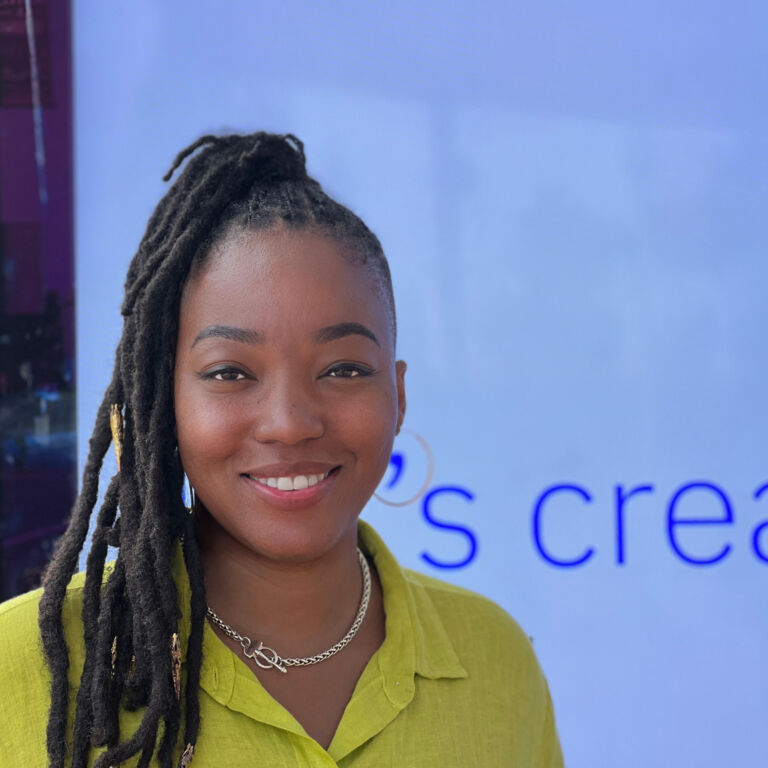
For Shani Sandy, VP of Experience Design at IBM, design has always been bigger than what it produces.
That’s why, in her work at IBM, Shani thinks just as carefully about designing the culture of her team as she does about the products they build. She crafts conditions where complex problems meet genuine creativity, despite the constant constraints of time and resources. Her success is partly due to the consistency of her guiding principles: center user needs and co-create rather than just consult; collaborate across engineering, product, and marketing (and beyond) because design never becomes real in a vacuum; and treat everything as a learning invitation.
As AI fundamentally reshapes how humans and technology interact, she has a clear message for designers: “Design’s greatest threat is not the rise of AI. It's the rise of AI at a time when designers have tied their value to the commerce engine.” Shani doesn’t see the danger of AI being the technology itself, but the condition the technology arrives into. “I view AI as a mirror to our profession, which has predominantly measured itself by what it produces. We have forgotten that the gift of design was never just the product. The gift was the vision, the intent behind the mark, the idea of what was worth making in the first place.”
Shani sees the shape of design evolving beyond just graphic, UX, industrial, product, motion, brand, game, interior, set, fashion, architectural, and so on. To her, none of these shapes are fitting enough for what is being asked of designers today, which is to design the relationship between humans and a technology that seemingly thinks, produces, decides, and acts.
“I envision three emerging spaces that design will shape,” said Shani. Those three shapes include: “Designing for Connection— translating between humans and machines and vice versa; Designing for Stewardship—resisting harm, rebuilding conscience, protecting citizens and the next generation; and Designing for Possibility—a return to deep, slow craft, which often is antithetical to our post-modern reality, and to modes of imagining, including speculative futures.”
Shani views the possibilities of design in the work happening at the d.school, where creativity is still treated as a critical orientation to investigate the world, where who sits at the design table is being asked honestly, and where the next generation is learning to design the conditions, not just the artifacts.”
Learn more about Shani’s work in her talk at the FUTURE NOW: Art of the Possible AI SUMMIT.