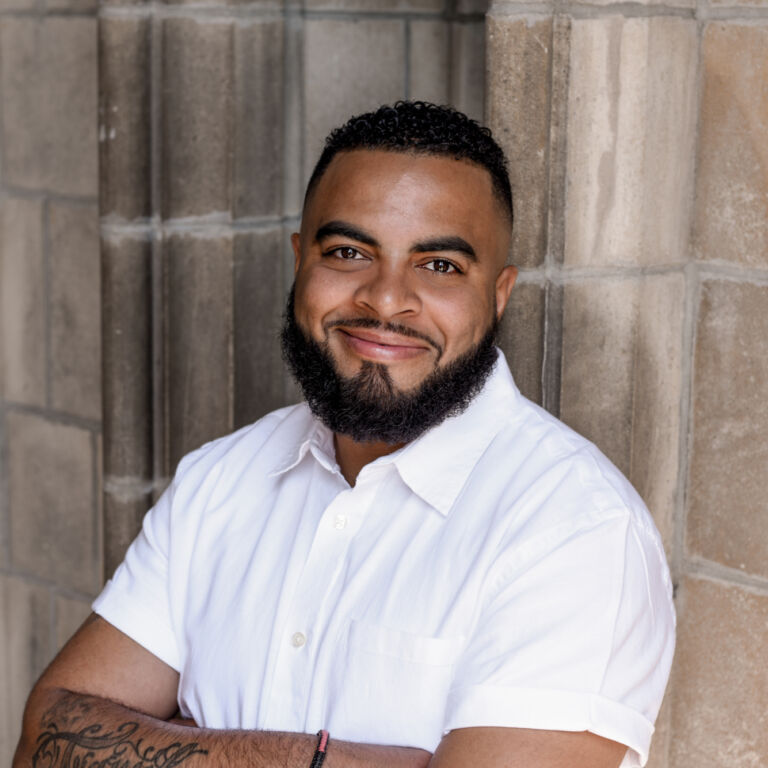
Chris Rudd is the founder and CEO of ChiByDesign, a social innovation design firm that helps create anti-racist outcomes for social sector organizations. The empathy, radical collaboration, and importance of co-design that makes the foundation of ChiByDesign were values that Chris honed during his time as a fellow at the d.school.

Heart to heart
Before coming to the d.school, Chris said he didn’t have a clue what design was. “It was like ‘scour the Internet’ and whatever showed up. Design was a word in a Google search,” he said. “Now I see how design impacts almost everything, yet it was something invisible to me. So, I wasn’t even let into the conversation about defining the word because I didn’t know who was doing it.”
Then, in 2015, he became a d.school project fellow and he started to understand the mindset, the rigor—and the fun—of design. “It was like Disneyland,” said Chris. He was able to connect with other fellows and start to understand the process.
One of his favorite moments were the backstory dinners, where one fellow would get to choose a meal and speak about their life, answering questions from their colleagues. Chris said, “That shaped our ability to become better designers. Getting to know someone allows you to understand who they really are and what they really need. And that’s the way we’re gonna figure out how to design for a better world.”
Chris says that learning design taught him new ways to be a father, to be more hands-on and crafty, but also how to be more empathetic, to make memories, and to focus on emotions. His person-centered approach is one of the core values of ChiByDesign.
Better for whom?
“To me, design is a way to bring people together to make the world better,” said Chris. “Better for who, for which groups? That all gets defined by those being part of the process, and that to me is why it’s so important to bring people together.”
When Chris returned to Chicago, he saw that a design firm working on a project in Englewood, a predominantly Black neighborhood, lacked any Black designers. “I thought, ‘There’s no way they’re going to get this right. They just can’t.’”
Radical collaboration was a major takeaway from the d.school for Chris: bringing diverse perspectives to the table to see what innovations came about. But in the design space in Chicago, he kept hearing that no one could find Black designers, even though Chris knew plenty of them.
These experiences helped launch ChiByDesign, which brings together designers of color to help the communities that they represent and identify with. The criteria for any project that ChiByDesign takes on is that it must acknowledge that race is part of the framing of the problem, and it must help communities of color. As a result, much of their work has remained within the social sector.
Openly listening
As someone from outside the design space, Chris values co-design and bringing non-designers in to collaborate and communicate what’s going on.
“Designers are not the experts. We have to trust the people who are closest to the problem and bring them in. Equip them with design tools, with design frameworks, and allow them to be the architects of their own destiny,” said Chris.
While co-design has a reputation for taking up time and resources, Chris says it’s vital. “People from these places inevitably always change the project in a way that is amazing. What you get is the right answer that we would not have come up with because we haven’t been through what they have.”
ChiByDesign recently developed a Maternal Success Kit with the New Jersey Department of Children and Families. They hired three mothers who had children removed by the state, and these women helped steer the course of the project.
Instead of just focusing on the baby’s health, the kit also includes and centers the mother, especially pre-birth. Chris says that designers have the unique opportunity to transfer power to their clients. “The client gives us a ton of power… I’m going to give it to this woman who you would not listen to for the last 18 years. And now you have to listen to her.”
Chris knows that hard data on how racism impacts people and communities is needed. He also understands that humanizing those who have been victimized by these systems is equally important. Those perspectives need to be included in the design world in order to target the systems causing harm.
“There’s this notion of being apolitical in the design field, and we’re just here to do a job. And I think that’s a very dangerous mentality, especially now,” said Chris. He encourages designers to keep leaning into their point of view for a more just world. “It’s more necessary now than ever before.”
Credits
Thanks to Tran Ha and Amalia Rothschild for originally interviewing Chris for the d.school’s “This Is Design Work” exhibition; Mark Grundberg for shaping the interview content; Second Peninsula for producing the video; the d.school’s academic team and teachers for guiding generations of designers; Eli Ramos for writing this article; and Jenn Brown for her persistently collaborative editing.