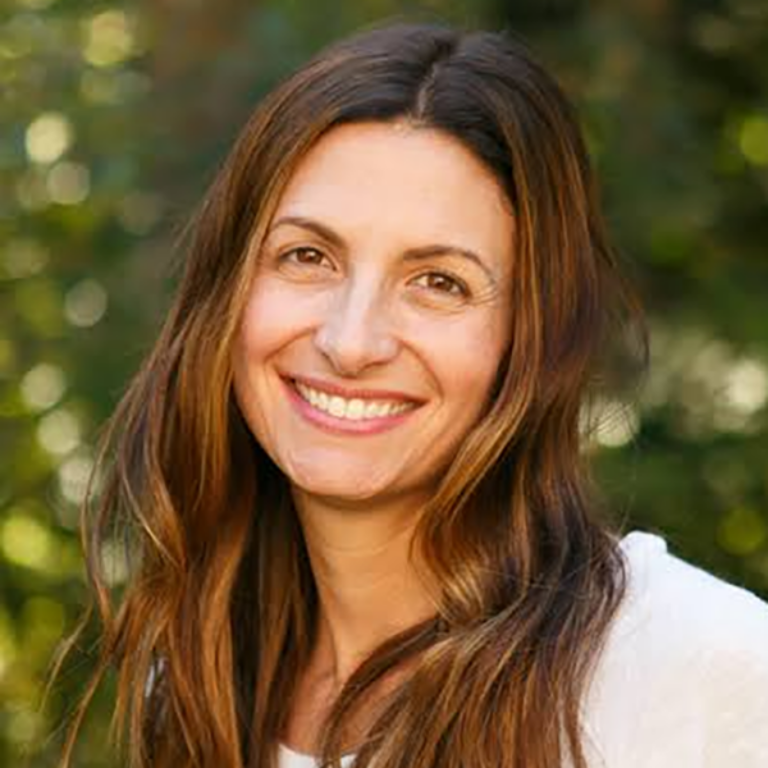
As a K12 fellow, Melissa Pelochino identified what would be the throughline of her work: design and dialogue. These concepts led her to co-found Clayful, a chat-based coaching service that aims to make mental health support accessible for every child, and it now guides her work as an edtech consultant for founders designing feel-good and functional products.
The lamp that changed everything
Melissa was a 6th grade teacher in East Palo Alto when her husband was an engineering grad student taking classes at the d.school. He asked if he and his team could come into her classroom to explore the design challenge of how to get students talking more.
In her classroom, the d.school team started with the obvious solutions: sentence starters, group activities, and games to build community. But when they began applying the principles of design, they had a path to explore the nonobvious solutions. It was then that they tried something different. They placed a small IKEA lamp in the middle of each table. And something remarkable happened: The kids leaned in. They gathered around the warm pools of light, moved closer to one another, and started talking. The problem wasn’t that the students didn’t know how to communicate, it was that the environment wasn’t inviting them to do so. An eight-dollar lamp had done what countless classroom strategies had struggled to do.
Their solution was a revelation. For the d.school students and for Melissa, the lamp highlighted design’s ability to both define problems and see solutions in new ways. This was Melissa’s introduction to design, and it changed the way she saw just about everything.
When a book becomes more than a book
Soon after, Melissa attended a Design Thinking Bootcamp at the d.school, where she said, “Everything clicked.” She began bringing design challenges into her reading groups. She had spent years helping students learn to read, but she knew getting kids to care about what they were reading was an entirely different challenge.
She asked herself, What if students weren’t just asked to understand a story? What if they were asked to do something with it?
At the time, one group was reading Monster by Walter Dean Myers, a novel about a 16-year-old boy on trial for murder. Instead of asking students to write a traditional book report, Melissa gave them a challenge: redesign the jail cell for the main character.
“In order to design for him, they had to interpret information that was provided when he talked about his jail cell and his experience in his environment,” said Melissa. She also took those students to visit a jail to interview officers and understand experiences firsthand.
During this project, one of the boys in the group had a father who was incarcerated. He had never wanted to visit him, but sometime after the project, his mother told Melissa that her son had asked to visit his dad. And when he went, he brought Monster with him and read to his father. It was the first time he had visited his dad and the first book he had ever finished. For Melissa, that moment captured something no reading assessment ever could: a book had become a bridge between a boy and his father, and design had helped build it.
That work paid off in other ways too, showing great outcomes for her students—and other schools asked her to lead professional development. That success also pulled her back to the d.school as a K12 fellow, where two concepts became the bedrock of everything she does: design and dialogically organized discourse, which prioritizes curiosity over correctness.
That foundation brought her to leadership roles in education technology, where she worked with companies including Nearpod and Seesaw, helping bring thoughtful design to classrooms around the world. Melissa says that it gave her the experiences and tools to found Clayful.
From crisis to prevention
Clayful originated from a clear need in the mental health space for kids. As an educator and a parent, Melissa had seen how much kids carry with them into the classroom: an argument with a friend, anxiety about a test, a difficult morning at home. Small things to an adult, but enormous to a kid. But Melissa also saw that we so often wait until students are in crisis before offering meaningful support. She wondered, What if we started further upstream? What if a student could talk to someone when the problem was still small?
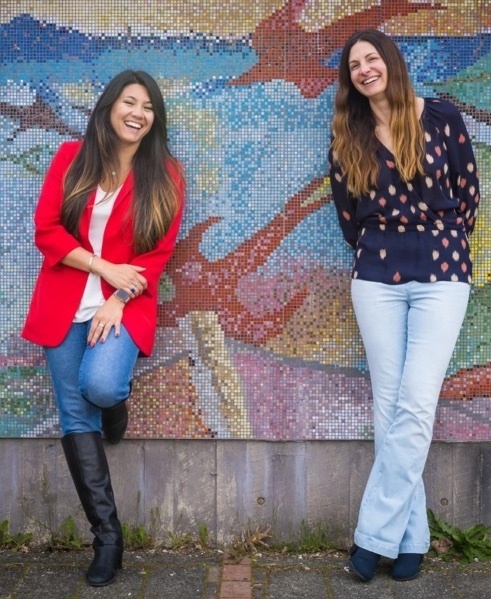
Together with Maria Barrera, a fellow Stanford alum, Melissa co-founded Clayful around that idea.
Curiosity served Melissa here, too. “Getting super curious about what things really mean” was part of finding solutions to the need for more providers. Working alongside behavioral health experts, Melissa helped develop a rigorous eight-week coach training program, translating proven strategies into practical skills that could be used in everyday conversations. The team combined human-centered design with established coaching practices to develop an approach that earned accreditation from the International Coaching Federation.
Clayful wasn’t designed to replace clinical mental health care, but rather to fill a gap that had been overlooked for far too long. The enormous space between feeling fine and being in crisis, a space where a little support, at the right moment, can make a meaningful difference.
Clayful now partners with schools and districts to provide on demand coaching for students, caregivers, and educators. Someone having a hard day can connect with a trained, trusted human coach in as little as 60 seconds.
Trusting, translating, and curating
Leaving Clayful to explore other opportunities, Melissa currently advises education technology founders, helping them turn ambitious ideas into products that solve real human problems. She’s also turning her attention to designing for the end of life. One question guiding her is, if design is about understanding human experiences and finding ways to make them better, isn’t dying one of the most important experiences we could design for?
Through working in these tough-to-navigate spaces, Melissa says she has learned to take risks. “I’m so unafraid of failure because I know how to use it as compost. And if your experiment is well-defined, the stakes are low enough where the whole mission isn’t going to explode if something goes wrong.”
She has also learned that meaningful work rarely moves in a straight line. Sometimes you work on a problem for weeks, or months, and nothing seems to change. “So much of creation and innovation is ambiguous,” Melissa says. “You don’t always see progress. But just because you’re not seeing the ice cube melt doesn’t mean the temperature isn’t rising.”
Melissa said, “Learning to trust the process again and again is really hard. But inevitably, it’s learning to trust yourself.”
Credits
Thanks to Tran Ha and Amalia Rothschild for originally interviewing Kareem for the d.school’s “This Is Design Work” exhibition; Mark Grundberg for shaping the interview content; Second Peninsula for producing the video; the d.school’s academic team and teachers for guiding generations of designers; Eli Ramos for writing this article; and Jenn Brown for her persistently collaborative editing.
