Quarterly Lecturer
• Undergraduate Design Program — Design 1, Design 11, Design 60
Quarterly Lecturer
Undergraduate Design Program – Design 1, Design 11, Design 60
The Stanford d.school seeks to grow our teaching community with exceptional quarterly lecturers.
Drawing from the fields of design and engineering, the d.school empowers our students to tackle complex challenges and build products, services, and experiences with transformative potential – in service of both people and planet. Our BS design degree program, MS design degree program, and university-wide elective classes are based on a human-centered approach to design.
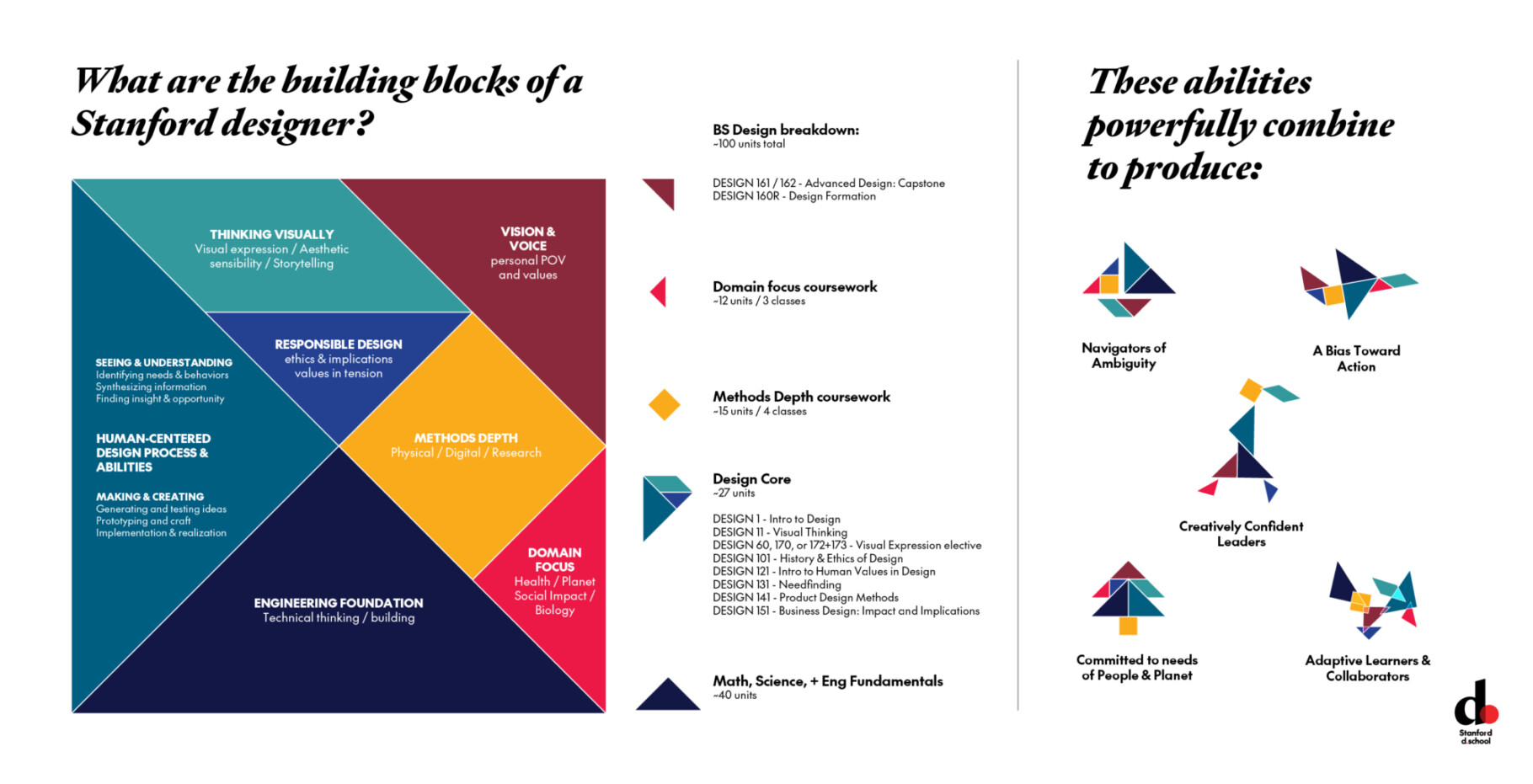
The BS design degree is a highly interdisciplinary engineering program where students learn to create across a wide range of domains. It combines an Engineering foundation, an integrated Design Core, a chosen Methods Depth (Physical Design & Manufacturing, AI & Digital User Experience, or Human Behavior and Multi-Stakeholder Research), and a Domain Focus (Designing for the Planet, Health, Social Impact, or Biological Futures), culminating in a capstone project.
We're looking for Quarterly Lecturers to help teach and shape introductory courses in the undergraduate Design Core – specifically Design 1, Design 11, and Design 60 – the courses where students first build these foundations.
What We're Building Toward
Our courses aim to produce designers who are navigators of ambiguity, have a bias toward action, are creatively confident leaders, are committed to the needs of people and the planet, and are adaptive learners and collaborators. The tangrams-inspired map below shows the combinatorial power of our curriculum.
The Role
This is a part-time, quarterly teaching appointment (25% time for 12 weeks). The ideal candidate will continue to teach with us across multiple years.
The Path: Trial Teaching Quarter → Co-Instructor → Lead Instructor
New hires begin with a trial quarter of co-teaching alongside a veteran instructor, designed to be a two-way container to determine if the appointment should continue. We will evaluate performance openly and collaboratively during this quarter, through:
- Regular check-ins with the lead instructor
- Incorporation of feedback into work and teaching
- Observation from d.school academic leadership
- Student reviews and feedback
Trial quarter commitments include:
- Onboarding sessions and planning meetings with the lead instructor in the two weeks before the quarter starts.
- Being present for all class sessions for your course
- Fully leading 2–4 class sessions
- Attending weekly teaching team planning meetings
- Fully in-person; this is not a remote or hybrid position
- Leading the curation of course materials and synthesis of student and teaching team reflections for sharing with the broader academic community
- Participation in broader d.school teaching community events across the year
About the Courses
Each course meets 2-3x/week for approximately three hours of in-person instruction. All are required courses for design majors.
Design 1: Introduction to Design (4 units)
Design 1 is a highly experiential and collaborative introductory course that explores the fundamental skills, methods, and mindsets of human-centered design. Through short-format team projects, students experience how to prototype and test concepts, research needs, and how to synthesize insights from data to spark novel ideas. The course incorporates real-world challenges through on-campus partnerships, and illuminates how design methods can be used to create positive impact in the world. The course also exposes students to possible career pathways for designers through an inspiring and diverse set of guest speakers and project leads.
Design 11: Visual Thinking (4 units)
Visual Thinking is a foundational “build to think” class for all designers and makers at Stanford. Through a series of design projects, students learn how to bring their creativity to life. Visual thinking, a powerful adjunct to other problem solving modalities, is developed and exercised in the context of three challenges. Students exercise their imagination, see more clearly with the "mind's eye", and learn how to do rapid visualization and prototyping. They advance their skills in building in the physical and digital world while strengthening their ability to generate and refine ideas.
Design 60: Visual Expression (4 units)
Visual Expression is a hands-on exploration of the elements and principles of design common to all the visual arts. Through a mix of theory, analysis, and practice students develop their ability to interpret visual content and produce effective imagery. DESIGN 60 is the foundational visual course for undergraduate Design majors, and a prerequisite for more advanced visual design and craft courses. DESIGN 160 satisfies the graduate Design visualization requirement.
We're also interested to hear about other courses within the Design Core you could teach as your involvement grows (e.g., Design 101, Design 121, Design 141) — tell us in your application.
Who We're Looking For
- 5–10+ years of professional experience in a design field (this is not an entry-level or recent-graduate role)
- Some teaching experience — while much of our experiential teaching style is learned through practice, we are looking for candidates who can incorporate past formal teaching experiences, coaching and facilitation.
- Multi-year availability for at least one quarter per year
Application Materials
- Cover letter: why you, and why now? What draws you to teaching? Which Core courses among Design 1, 11, and 60 could you see yourself teaching? And what about other Core courses beyond those?
- CV / resume
- A teaching sample: a syllabus, curriculum sample, or short video clip. If you haven't taught formally before, a portfolio or work sample that shows how you communicate, facilitate and mentor is a welcome substitute.
- Student reviews, teaching evaluations, or references (if available) or at least one reference who can speak to your ability to teach, communicate, or mentor
Compensation & Logistics
Quarterly payment: approximately $7,000–$10,000 per quarter, depending on experience and course-specific details. Most of our current quarterly instructors are employed full-time or part-time elsewhere and have found a way to incorporate a quarter of teaching into their schedule alongside their main job or practice. Professional practice alongside teaching really deepens our students’ learning experience.
Because the role is in-person only and the compensation doesn't support relocation, we're likely looking for candidates already based in or near the Bay Area.
This role is not benefits-eligible. Non-compensation benefits include invitations to our teaching community events and involvement in the d.school community and Design Program's teaching culture.
Review Process & Timeline
October 16 - Winter Quarter Teaching Application Deadline
Our committee will begin reviewing complete applications for teaching appointments for Winter ‘27
December 31 - Spring Quarter Teaching Application Deadline
Our committee will begin reviewing complete applications for teaching appointments for Spring ‘27
We welcome applications after the deadline for future consideration.
Questions and applications can directed to both:
Stacey Gray, d.school Chief of Staff
stacey@dschool.stanford.edu
Kelly Schmutte, Director of Undergraduate Studies, Design
kschmutte@dschool.stanford.edu
Please use Subject line: “APPLICATION: Quarterly Lecturer”
Our Commitment to a Diverse Community
The d.school is committed to supporting a diverse community. People with personal or professional experience as part of communities of color and historically marginalized groups are especially encouraged to apply. Stanford is an equal employment opportunity employer. All completed applicants will receive consideration for employment without regard to race, color, religion, sex, sexual orientation, gender identity, national origin, disability, protected veteran status, or any other characteristic protected by law.

